

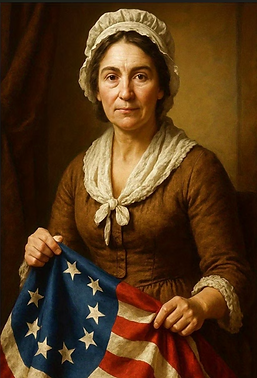
Time to Celebrate! 250th Anniversary of America!
250 Years Ago, Abner Thorp Entered the Service of His Country in the Quartermasters Department and Remained Actively Employed in the Army Until the Close of the War of the Revolution.
Abner Thorp is highlighted in PIONEER FAMILIES OF NORTHESTERN NEW JERSEY, by William C. Armstrong, published 1979 Genealogy Publishing Co. Abner was born Feb. 22, 1731, in Woodbridge, Middlesex County, NJ, sharing his birthday with George Washington. At the time of the Revolution, he was living at Smith’s Cove, Orange Co. NY. He had been married to Eunice Brown since 1753, and they had 10 children. They lived near their daughter and son-in-law, Silas Reynolds.
In 1776, Abner signed the Association Test and enlisted in the Quartermaster’s Department. That was a small organization responsible for supply activities that were to furnish all camp equipment and tents, and when the Army went into winter quarters, provided the lumber and articles needed to provide huts for the troops. It also had responsibility for providing transportation to the Army. The department was handicapped by having virtually no money or authority, and it was dependent upon Congress and the states for supplies. It was mentioned in “Pioneer Families” that Rev. Joseph Greenleaf, in his genealogy of the Greenleaf Family, called Abner Thorp “the French war correspondent of General Washington.” No verification of this has been found. There are two possible reasons. First, sometimes family stories, passed down through generations, become embellished. The second reason is based on information about The Committee of Secret Correspondence. That committee was formed by the Second Continental Congress and active from 1775 to 1776. It played a large role in attracting French aid and alliance during the American Revolution. In 1777, the Committee of Secret Correspondence was renamed the Committee of Foreign Affairs. Most of the efforts were for forging alliances with foreign countries that would sympathize with the patriot cause. The committee also employed secret agents abroad to gain foreign intelligence, conduct undercover operations, start American propaganda campaigns to gain patriotic support, analyze foreign publications, and develop a maritime unit separate from the Navy. The Committee requested that the Continental Congress keep information about members of the Committee and their actions confidential. If Abner was a correspondent, that information would not be verifiable.
In 1779, Abner, while living in Bloomingdale, precinct of Newburgh, NY, bought land in Monmouth County, NJ from Hendrick and Barnes Smock. A description of that property says:
DEED BOOK F-2 pg. 480
Hendrick Smock, Freehold with consent of Nelly his wife as testified by her signing;
and Barnes Smock Middletown and Nelly, his wife as testified by her signing
conveyed to Abner Thorp for $1800,
a tract of land at a place called Squankum, on the south side of Manasquan River, beginning at the river where Jonathan Marsh’s line crosses the river opposite William Morris,
1. then running easterly along Patent line 47 chains (3,102 ft) to a sassafras stake standing on north side of Timber Swamp Brook where Marsh’s Patent crosses the brook;
2. then running Southeast 37 chains (2,442 ft) to 4 Spanish oaks on one stump, being the southwest corner of Benjamin Thorp’s leased line;
3. east along leased line 23 chains 50 links, (1,551 ft) to a red oak marked on 2 sides on bank of Manasquan
River on course west 4 chains to mouth of Timber Swamp Brook,
4. then from red oak up the river to the beginning
containing 208 acres
Bounded on north by Manasquan River, west by William Morris and Anthony Smith, south by lands formerly Peter Parker and east by Benjamin Thorp
Note: surveyor chain is 22 yds long or 66 ft long and has 100 links
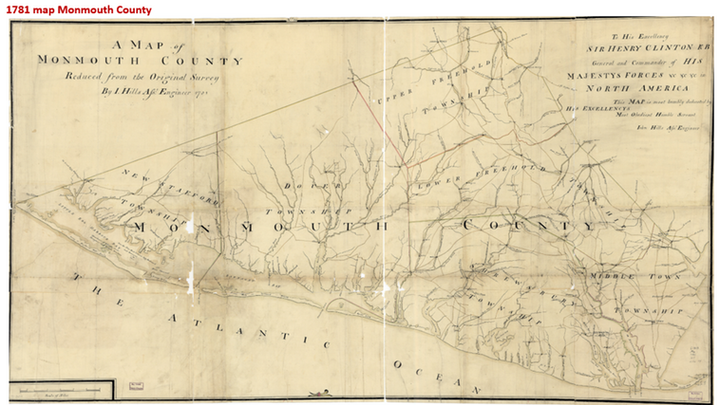

At the close of the War, Abner retired to his farm in Monmouth County. Marl was sold from his farm and marketed as fertilizer, and his homestead was named the Marl Valley Farm.
Abner and Eunice had a total of 14 children. When they moved to Monmouth County, 13 children went with them. Eunice died in 1801 and was buried on the farm in a section called the Thorp Family Burial Ground.


Abner died 1812 and was buried next to Eunice. His head stone is much larger and includes a lot of information about him. Unfortunately, it is so worn, it is difficult to read, so one of his descendants, Margaret Forsberg, with the help of the DAR, was able to get him another marker.
Abner’s original tombstone says: “Abner Thorp, born on the 22nd February 1731. He entered the service of his country in the Quartermaster’s Department in the year 1776 and remained actively employed in the Army to the close of the War of the Revolution. He was an ardent and devoted Whig and the personal friend of the father of his country. At the close of the War he retired to his farm in Monmouth County, where, in the discharge of every parental and social duty and in the enjoyment of a living faith in the Mercies of his Divine Master, he continued to dispense his benevolence until his pure spirit was summoned home on the 4th of December 1812, in the 82nd year of his life.
"O’ sing unto the Lord a new song, for he hath done marvelous things; his right hand
and his holy arm hath gotten him the victory.” From Psalm 98, first verse
Abner had a 2nd wife, Anna, who had no children. In 1814, she sold her dower right to land on the south side of the Manasquan River to her stepson, Benjamin Thorp for $100.
There is a broken stone (broken off at the ground) next to Abner, and there is a footstone with the initials H. T. Abner did have a daughter, Hannah, but she seems to be buried in another state. There has been a guess on ancestry.com, that perhaps Anna was actually named Hannah. No verification of who is in that other grave.
Benjamin Thorp was born Oct. 21,1759, died Aug. 25,1814 and buried next to his mother, Eunice. He was administrator of his father’s estate, but he died before it was settled; but eventually, it was settled by John B. Thorp, Abner’s son and Benjamin’s brother.


John B. Thorp obtained title to the 208 acres. There are deeds showing that siblings sold their shares to John B. When he died, he left a will dated 1841 giving loads and loads of marl to his neighbors. The property later became known as Longstreet Farm.


